Under Component 1, this is the SCS SAP's core implementation work, focusing on site-based solutions at SAP target sites to achieve habitat conservation and management targets.
Objective: Reduce habitat degradation and loss via national and local reforms to achieve specific targets for mangroves, coral reefs, seagrass, and wetlands.
Core focus areas:
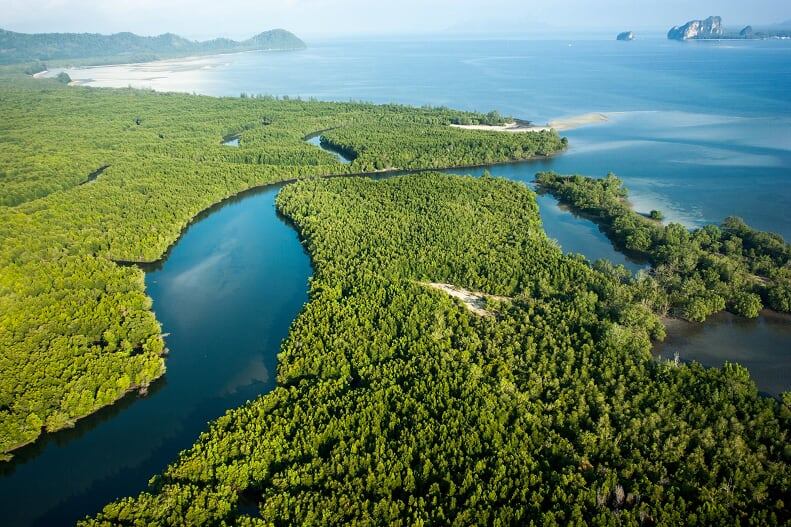
- Mangroves: Supporting the declaration of 57,400 ha as National Parks and Protected Areas, including designation and plans for the management of 166,600 ha, sustainable use regulations and reforms for 602,800 ha, and replanting/enrichment efforts.
- Coral reefs: Aiming for the sustainable management of 110,430 ha at 46 sites, including reducing the decadal rate of degradation in live coral cover from 16% to 5%.
- Seagrass: Securing sustainable management with supporting laws for 26,036 ha, amending existing Marine Protected Area (MPA) plans, and designating 7 new MPAs focusing on seagrass.
- Wetlands: Supporting the development and implementation of integrated management plans for 813,647 ha, including the declaration of at least 7 wetland areas with protection status
Current progress & variance: National pilot activities in Cambodia, China, and Thailand are on track. However, the Philippines and Indonesia pilots, launched in November 2024 and May 2025, respectively, require significantly more time, and Viet Nam faced delays in finalizing the agreement.
Variance/integration: The third, most recent Project Steering Committee (PSC) Meeting in Manila in May 2025 approved the integration and use of USD 450,000 in remaining funds from the separate GEF/UNEP/SEAFDEC Fisheries Refugia Project to support these pilot sites, particularly where the two project areas overlap. This integration is viewed as complementary, ensuring lessons and support for habitat conservation continue.
MANGROVES [16] |
|||
| Cambodia |
Prey Nob District |
Philippines | Busuanga Coron |
| China |
Shankou, Guangxi |
Thailand | Bandon Bay Pak Panang Bay Welu River Estuary |
| Indonesia | Batu Ampar | Vietnam |
Tien Yen |
CORAL REEFS [16] |
|||
| Cambodia |
Koh Kong archipelago |
Philippines | Busuanga and Coron Batangas, Maricaban Strait (Mabini and Tingloy) |
| China |
|
Thailand |
Sichang Island Group |
| Indonesia | Bangka Belitung |
Vietnam |
Bach Long Vi |
SEAGRASS [14] |
|||
| Cambodia |
Kampot Beach |
Philippines | Busuanga Coron |
| China |
Hepu, Guangxi |
Thailand | Bandon Bay |
| Indonesia | Bintan Mapur |
Vietnam |
Phu Quoc archipelago |
WETLANDS [13] |
|||
| Cambodia | Koh Kapik Ramsar Site Chumpu Khmao Kampong Trach |
Philippines | Malampaya Sound Estuary |
| China | Pearl River estuary (Jitimen), Guangdong Dahu, Guangdong Maoweihai, Guangxi Danzhou (Xinyingwan), Hainan |
Thailand | Don Hoi Lot Mudflat |
| Indonesia | Sembilang Sector of the Berbak Sembilang NP | Vietnam | Thai Thuy Wetland Protected area Thi Nai lagoon Tien Giang wetland in Tien river estuary |