Dear SCS SAP Colleagues and Friends,
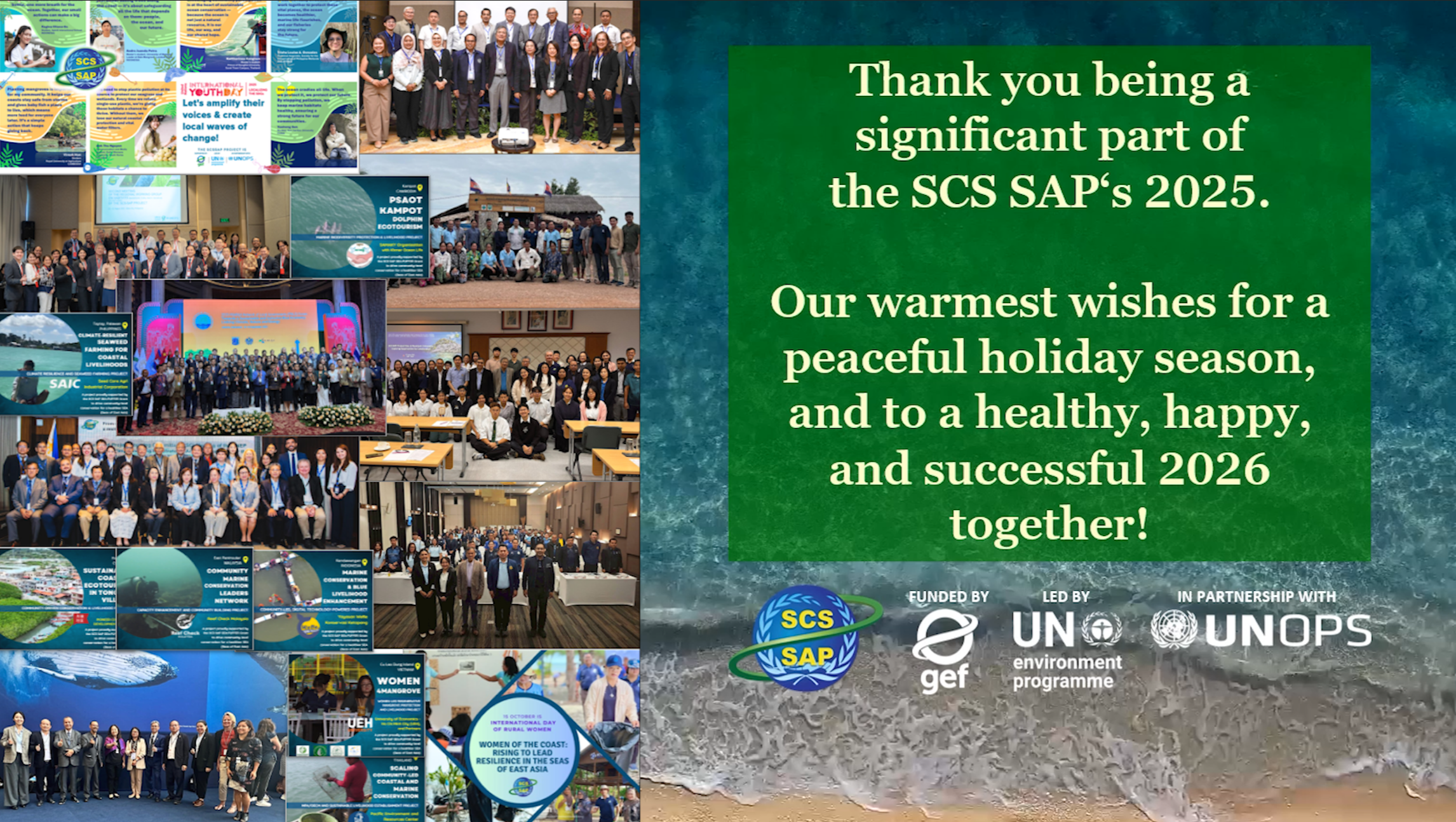
As 2025 concludes, on behalf of the Project Coordination Unit (PCU), I want to reflect on a truly pivotal and impactful year for the South China Sea and Gulf of Thailand (SCS-GOT) Large Marine Ecosystems (LMEs). This year was defined by critical decisions, invaluable in-person collaboration, and the meaningful expansion of our growing SCS SAP family.
Evaluating progress and setting priorities
Our year began with the Mid-Term Evaluation (MTE) in the first quarter, which was critical for defining the path toward a successful and sustainable project conclusion. The MTE process resulted in key recommendations, including a project extension until December 2027 and a decision to further integrate our activities with the COBSEA.
This direction was formalized during the Third Meeting of the Project Steering Committee (PSC) in Manila, Philippines, in May. The PSC, with representatives from our six participating countries, UNEP, and UNOPS, made crucial decisions based on the MTE recommendations, enabling us to implement adaptive management and strengthen commitments at our project sites.
Knowledge sharing and global engagement
A major highlight of 2025 was the successful return of in-person Regional Working Group (RWG) meetings, bringing local and regional experts together to share vital knowledge and practical experience, and evaluate and enhance SCS SAP implementation:
-
Coastal and Marine Ecosystems: Second Meeting of the RWG in Iloilo, Philippines (August).
-
Land-Based Pollution: Third Meeting of the RWG in Batam, Indonesia (November).
-
Economic Valuation: Meeting of the Regional Task Force held online (December).
We organized the SCS SAP Project Day in our host organization Kasetsart University Faculty of Fisheries to introduce the SCS SAP to inspire and engage with the next generation of marine scientists and conservationists. We also participated in key global and regional events, including the 10th Our Ocean Conference (Busan), 24th Annual Large Marine Ecosystems Consultation Meeting (Athens), the Third UN Ocean Conference (Nice), the COBSEA Accelerating Marine and Coastal OECMs Workshop (Iloilo), the SCS SAP-PEMSEA Learning Exchange (Jakarta), and the First Asian Regional Dialogue on Seagrass and Dugong Conservation (Bangkok), and the Second WESTPAC Workshop on Marine Spatial Planning (Pattaya). These platforms were instrumental in highlighting achievements, sharing best practices, and discussing lessons learned from the site-, national-, and regional-level implementation of the SCS-GOT Strategic Action Programme.
In an initial step toward securing long-term impact, we collaborated closely with COBSEA during their Working Group on Marine and Coastal Ecosystems (WGMCE-3) and their Task Force for the Strengthening of the COBSEA. We look forward to deeper integration in 2026.
Expanding our family and reach
We significantly expanded our reach and network this year:
-
PCU Experts: The PCU team is now complete with additional experts, ensuring all SCS SAP activities are on track.
-
Regional MPA Network: The East Asian Seas Regional Collaborative Network of MPAs, which began discussions in late 2024, gained incredible momentum. Thanks to the dedication of nine regional organizations (on voluntary commitment!), we convened five online meetings, a workshop, and three official side-events at the 10th Our Ocean Conference in Busan and the Third UN Ocean Conference in Nice, creating a powerful, sustained forum for MPA management.
-
SEA Grantees: We officially launched our seven SEA Grantees, making our work more impactful by actively involving people whose proximity to the coasts and stakes in conservation are highest. They are now integral members of the SCS SAP Family.
Updating foundational science
A significant undertaking this year was updating our foundational document: the Transboundary Diagnostic Analysis (TDA). The last TDA was completed over 25 years ago! Regional and thematic TDA 2.0 experts have been diligently researching new trends, grounding the analysis in the context of the three planetary crises: Climate Change, Pollution, and Biodiversity Loss.
-
Our Regional Team of Experts is leading this work together with National Coordinators and Focal Points focusing at the national level. We are progressing well, with national and regional TDA reports due before the end of the year.
-
Our goal is to secure endorsement of the TDA by the COBSEA Intergovernmental Meeting (IGM) in October 2026.
Finally, with support from GEF IW:LEARN, we shared impactful stories from our partners and stakeholders with the wider International Waters community. We successfully launched our new website (scssap.org) in November and welcome your feedback as we continue to improve our communication tools.
Top 5 Priorities for 2026
-
Successfully complete the updated TDA 2.0, resulting in recommended priority national and regional actions, and secure endorsement from policymakers.
-
Launch SEA:LEARN, a new AI-backed Regional Knowledge Gateway on coastal and marine ecosystem management.
-
Sustain the MPA Networking Meetings to enhance regional collaboration on protected area management, resulting in tangible outcomes such as regional MPA mapping and collaborative project proposal development.
-
Launch SEA:PUFFER, a new innovative long-term sustainable financing mechanism to enhance marine and coastal management in the region.
-
Progressively embed the SCS SAP's work and outcomes within the COBSEA to secure enduring long-term impact.
I want to extend my deepest gratitude to the entire project team — Ivan, Jimin, Khristine, Kong, Marvie, Ob, Rey, and Tuan — as well as our six dedicated National Coordinators — Sopheak, Pei, Heru, Romy, Suwimol, and Chinh — for your hard work, dedication, and adaptability throughout 2025.
We wish you a rejuvenating holiday season and meaningful time spent with your loved ones, and all the best for the new year.
Sincerely,
Anders